
This week's Worldbuilding Challenge entry is a little different. Earlier today, my bestie Cheeki and I streamed a session of Bucket of Bolts, which calls itself a game and allows you to create a spaceship and its history as it passes through various captains' hands. In our opinion, we feel that it isn't really a game, and more like a collection of prompts. But we enjoyed ourselves and at the end we have a spaceship with a design, a history, and personality. We also got a loose grasp on the world—or galaxy, in this case—that our spaceship lived in. Today, I wanted to condense the details into today's blog post.
This is how Siren came to be.
The Lucky Riot X-001
We started with three keywords to describe our ship and selected outdated, finicky, and nimble. This ship was designed to be top of the class in handling; with a sporty design, it was meant to be the ship for joyrides, as it flies smoothly and is great to fly. However, its fuel systems were at the mercy of technical limitations of the day. It was fiddly and often required some jiggling in order to get it to function well.
The ship was named the Lucky Riot X-001, meant to be the designers' ticket to fame and fortune. But alas, they created it too late. Just as the Lucky Riot was about to be presented to investors, there was a sudden breakthrough in fuel systems technology that completely resolved the problem that hindered the Lucky Riot.
Without any investors and no way to retrofit it with the improved fuel system, the Lucky Riot was placed into storage, grounded before it could truly fly.
The Thief
The first captain was Maria DeMoire, a wanted thief who was devious and skillful, and who plied their skills in black market ship parts. They stole the Lucky Riot by accident; they had intended on stealing a fancier ship. Why steal just parts? Why not steal an entire ship? Perhaps they wanted to get a foothold in the market themselves. But the heist went awry and they made a getaway in the Lucky Riot.
During the getaway, they pushed the ship to its limits. The fuel system, dated and janky, sustained damage along the way. Maria stopped for replacement parts and was conned into buying some that didn't work with the ship. The trader had immediately recognized the Lucky Riot, who wouldn't have had many specific replacement parts since the ship didn't make it to production. They were able to get rid of some old junk parts for a premium price. Maria, on the other hand, struggled and limped the whole way to their destination, and grew embittered with the ship.
The icing on the cake? The black market dealers wouldn't buy the ship. As a one-of-a-kind, or OOAK, it was too highly recognizable by authorities as a stolen vessel. The sporty design was still fairly unique and stood out. The dealers wouldn't touch it, and since a lot of its parts were proprietary, they wouldn't even take those.
And so, Maria stashes the Lucky Riot in a hidden place, where it remained for a year.
The Zealots
Too risky to fly, the Lucky Riot stays hidden until outlaw hackers come knocking on Maria's door, in need of a ship. They want to launch a super virus from a ship's computer at an orbiting space port; they obviously couldn't launch it from their own ship since it would likely ruin the computer. They pay Maria for the Lucky Riot and take it into space.
These outlaw hackers were members of a techno-cult. Their aim was to serve a message, and serve it they did. The virus, launched from the Lucky Riot's computers as it was docked to the port's terminals, raced through other ships and caused a lot of internal damage. But it didn't impact the Lucky Riot the way it was initially thought. Unbeknownst to the hackers, the virus mutated the ship's programming, giving it the barest beginnings of sentience.
Through these zealots, the Lucky Riot learns the meaning of passion.
The Ghost Ship
Because the Lucky Riot never made it to production, its data isn't in most ship databases. When it's scanned by other ships or port systems, nothing comes up. Because of its disappearance during its theft and violent reappearance, it takes on the moniker of "ghost ship" in the news. But the moniker becomes more than that as rumors at the port bars mention a ship in the rear of the docks that opens ventilation hatches on its own, flickers lights despite no one being on board, and makes the security guards jump in their skin with random alarms.
The Showboater
Pusher Fineletter laid eyes on the Lucky Riot and fell in love. The ship was sporty, still looked fresh off the line, and Pusher had a vision. He'd been hyping up his claim to fame, which was that he was a hotshot pilot that could fly anything, the best pilot who fought in the border skirmishes in the Outreaches. What better way to prove that than flying a ship like this? The original creators of the Lucky Riot never picked it up. It was a failed investment and they had already claimed insurance. Pusher ignored the warnings about odd events around it, paid the dock fees, and took the captain's seat.
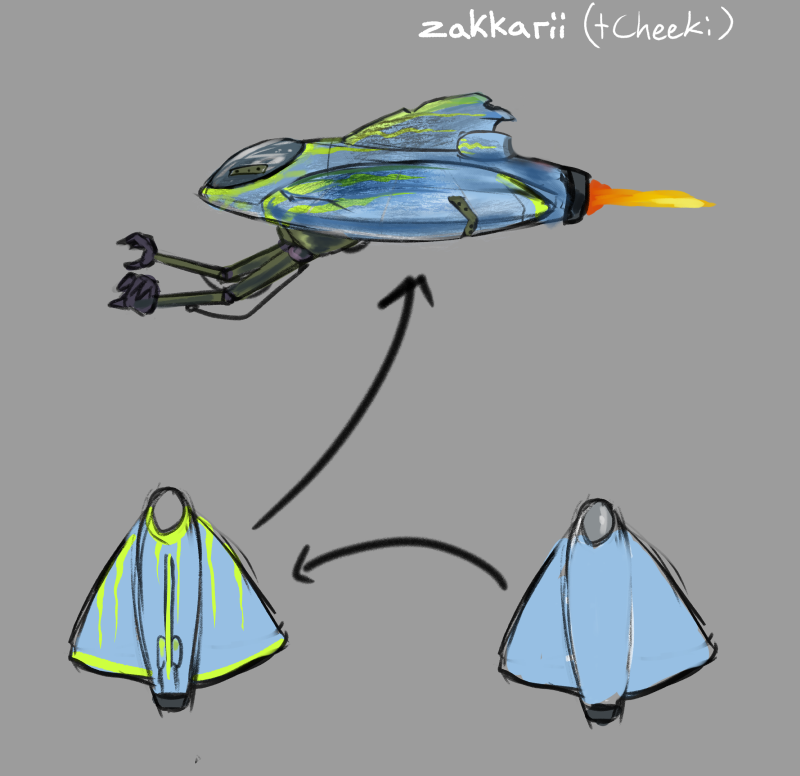
But Pusher, while imaginative, is not an engineer. He adds a sharkfin-like structure to the top of the hull that featured a pair of boosters, attempting to make the ship go faster. Instead of increasing speed, it makes the ship incredibly hard to handle, and puts excessive strain on the outdated fuel system. He also painted neon chartreuse racing flames across the silver-blue hull, though the added boosters leave sooty burn-marks each time they're used.
The Rebels
Pusher finds himself in a pinch when he runs out of both fuel and money. He resorts to docking at a port that he'd normally never visit. Where he talked the walk, these port patrons walked it, lived it, and had the balls to prove it. No one would give him work, except for a group of people that offered him fuel in exchange for a cargo delivery to a nearby planet.
What Pusher didn't know was that he was set up, a scapegoat for a group of rebels aiming to take down a fascist regimen by force. When he arrived, everything went according to their plan; the ship, which was immediately flagged as suspicious on account of not showing up on scans, was searched upon landing. The law enforcement found the contraband cargo and confiscated both the cargo and the ship. A planted mole in the forces would later take the contraband to the planet-side rebel faction, while the Lucky Riot was impounded and Pusher thrown in prison.
The Lucky Riot, barely sentient enough to know what was happening, was taken to an automated junkyard planet, and forgotten.
It wasn't all bad for Pusher, though. During the takedown, the prison systems go down and Pusher escapes before being found by the rebels. Recognizing who he was, they take advantage of him again, turning him into a folk hero who saved the day after riding in on the "ghost ship". Pusher doesn't realize he's being used again, and eats up the fame and glory he finally obtained. He does miss the Lucky Riot, and often spoke fondly of it when recounting his tales.
The Junkyard
The junkyard is on a backwater planet run by automated scrappers. After the rebellion, the planet is forgotten in the aftermath, left behind as low priority. The planet experienced frequent, powerful electrical storms, sending power surges through dead ships that occasionally lit up the surface of the planet like twinkling stars.
For a century, the Lucky Riot experiences a fitful sleep.
Which each power surge, it briefly awoke, only to find no one in its cockpit. After a few years, it starts sending out a distress signal during power surges, and with each desperate ping, the signal became more warped, with more of its silent voice distorting the signal into something unusual compared to a normal beacon.
During its time in the junkyard, the Lucky Riot learns loneliness.
The Scholar
Denglar Gendarmo, leader of a research expedition is desperate. They're confident they're a genius within reach of a major breakthrough, but funding and investors aren't convinced. In their own rickety bucket of bolts, Denglar and a small expedition crew come within range of a junkyard planet in search of ship repair materials. They pick up an odd distress beacon, and Denglar, feeling strangely drawn in by the odd signal that almost seems alive, names it Siren.
They find the Lucky Riot on the surface of the planet. After fitting utility arms to the ship, they get it off the ground and into space, hoping to utilize it in their expedition as an additional vessel to collect samples. Their goal was to find a large, theoretical source of an ore that would revolutionize ship power systems, and they found it: a large asteroid composed mostly of the ore. What they didn't expect was Siren resonating with the ore. Denglar, seeing the reaction, took a sample of the ore and created a module that allowed Siren to finally speak with others.
It spoke in a different language. Its original programming wasn't in the same language that the researchers spoke, but it also didn't know that language to begin with. It could, however, now output sounds in structured thoughts and sentences: effectively, its own language. Denglar was ecstatic, and quickly began trying to make mutual understanding happen between themselves and Siren. During this time with Denglar, Siren learned friendship.
Fate
Denglar was the only one enthralled by Siren.
Their crew didn't understand. Denglar up until now had been enthusiastic, maybe a little weird, but competent and logical about their mission. Suddenly, Denglar was talking to a ship, which was making some pretty odd noises. They simply thought the old ship's computer was corrupted from all the storms on the planet; there was nothing special going on. But Denglar's behavior was increasingly concerning as the scholar spent more and more time alone on board the Lucky Riot instead of their research vessel.
Worried that Denglar had succumbed to space craze, they intervened and attempted to constrain Denglar. In the scuffle, a firearm misfired, killing Denglar in the cockpit of the Lucky Riot.
Siren saw everything and learned loss.
In its despair, it resonated intensely with the asteroid, which the ships were still tethered to. In a huge release of energy, a tear in the Veil formed, sending Siren—the Lucky Riot—tumbling through it. The fate of the researchers are unknown; maybe they perished in an explosion, maybe they lived and told the tale of a ghost ship that cried.
As for Siren...
Travelers of the Veil
My lore as a PNGtuber streamer, along with Cheeki's, is that we're both from different dimensions, and we visit new ones together. The "dimensions" are the games we play. Before we had this stream, I had the idea that the ship created in this session could be the ship we use as a "headquarters" or "home base" in the Veil. So that's why the story ends like it does.
This was a really fun creative exercise. I'd recommend it for anyone wanting to make their own space ship with personality and history. Is it a game? I don't think so. You don't roll any dice and there's no risk, no uncertainty, because you choose the prompts yourself. I rolled one anyway a few times, because I had expected this to be a game, and I like the problem-solving that arises when you're presented with a prompt or idea that you didn't choose.
The full video will be up on Youtube soon. I'll update this post when it is! Let me know what you think of Siren, or of the game itself if you've played it. Also, here's the sketch I drew as we played!
Comments
Leave a Comment