Zakkarii Aarlen

Month: February 2026

Card image cap

Today's worldbuilding post isn't 100% mine! I did a prompt and oracle workshop stream today on Twitch, and with chat's help, I went over how I utilize them in my solo gaming. Big shoutout to AmayaOkami, who inspired the stream! Another shoutout to LondonStation who brought in a couple folks, one of which taught me about soapnuts.

Let's see what we came up with!

Game-Provided Prompt Tables

Some solo TTRPGs include their own prompt/oracle tables (we'll just collectively call them prompts). Legends of Akeroth, my current system for a solo campaign game, is one of these. It features several prompt tables along with a d100 table of biome-specific events for journeys. I utilized three of them to show how I think my way through them.

Scene Spark Tables

This d66 table is a collection extremely short but coherent sentence prompts. The book suggests using it when you want a quick answer to "what happens next", like if you were to exit a shop and weren't sure what to do after that. A prompt I rolled was:

A messenger arrives with urgency

This prompt felt a little too open. Where is the messenger from? What is the urgent matter? So, I used two other tables in the book, on the previous page, in fact. These were "Action" and "Theme", two more d66 tables but with single-word entries. I rolled:

Action: Escort Theme: Balance

The idea I worked out for these prompts developed as follows:

A member of an escort for a person of importance, perhaps nobility or royalty, comes running in a panic. The escort group was attacked and slain, while the person they were escorting was kidnapped. This is a huge matter of importance because the person is linked to the ruling body of a nation, who is experiencing high tensions with another nation and the fear of war is very real. Perhaps this kidnapping was done by the rival nation...or perhaps it was staged to look that way by a third party that seeks to benefit from the two nations going to war.

This idea utilizes the "urgent messenger" as a surviving member of an "escort" group, and this event could upset the "balance" that is the relationship between two rival nations.

Juice Oracle

There are also system agnostic prompt tables that you can utilize in any game. The one I used for this example is a free one-page prompt resource called the Juice Oracle. The drawback is that it's only designed for printing it double-sided, so using it as a PDF may be a little annoying for those that are unable to print it. I've been greatly enjoying it, though, because it has four d100 tables for NPC dialogue topics.

Treasure Prompts

First, I rolled a piece of loot or treasure using an object/treasure table series.

  • Category: Armor
  • Quality: Tattered
  • Material: Adamantine
  • Type: Boots

At first I thought, oh, it's a pair of leather boots with adamantine armor plates strapped or sewn on, and the leather is tattered. But tattered leather is a little harder to imagine, and I doubt anyone would be interested in the boots as loot. So I considered maybe the boots had some sort of fabric element to their design, which led to me imagining them having a fabric lining on the inside.

Perhaps this lining is what's tattered, something that could be repaired if you took them to a cobbler. And, the reason the interior is tattered is because some kind of critter, like a mouse, has chewed up the fabric lining for a nest. And maybe the boots are still inhabited! The critter could be a sign of what the player just experienced; maybe they just fought the critter's friends. Or, a sign of what's to come.

Maybe they should be careful about entering the next room, lest a swarm of dungeon-dwelling critters overtake them.

NPC Dialogue

Since I use the NPC dialogue tables a lot, I wanted to show a couple of examples of how someone could use them. I imagined the context being that you, the player, have walked into a tavern and want to talk to the tavern keeper. I rolled once on three of the tables, which are varying topics of conversation. Here are two of the results:

A spiritual loss involving (blank).

This one got a bit grim-dark, but my first idea was that a god died recently and this tavern keeper was a devout follower. If this was a setting like Lordsworn or a Blackoath game, this could probably fit right in. Perhaps you're a cleric or paladin of this god; maybe the sight of you brings relief to the tavern keeper, or maybe they're repulsed by you. Maybe you both experience a moment of shared grief.

Another idea, which, uh, was equally dark if not more, was perhaps the tavern keeper had been fervently praying for the safe return of their little girl, who's been lost in the woods. But the prayer has gone unanswered—resulting in the loss of faith—and now the tavern keeper just wishes to find her body so they can lay her spirit to rest, at least. This would be a great plot hook for a quest to go into the woods and look for the little girl.

And she doesn't have to be dead! Maybe some mischievous fae or spirits lured her away, and when you find them, you have to solve a puzzle or make a bargain to get her back.

Rumors of an NPC's past.

I had a more light-hearted idea for this one. There's a rumor about the local bread maker's past—which may or may not be true, since it's just a rumor. Maybe they're the real murderer of their husband, who died in an accident. Maybe they're actually a famous thief who used to tear it up in the big city, and their treasure trove is in their cellar. This could be an excellent social mechanic situation with a bit of mystery.

The Story Engine

This is what I consider to be my heavyweight champion of prompts, the ultimate toolbox. Well, almost ultimate, because I don't have all the expansions I want for it, but I digress. The Story Engine features three core decks, one for story, worldbuilding, and lore. They've shown up on my blog and in my gaming already. I even used them to write a short story that you can read for free (check my books tab!) This section of the stream covered three different ideas, but I encourage you to check out the video of the stream to see them all.

Anyway, here's the group of cards I drew from the Story Engine deck and what I attached them to:

  • Scam Artist
    • Charismatic
    • Silence
  • Wants to pledge their life in service to...
  • Flask
    • Celestial
    • Element
  • But they must find something they lost long ago

After some back-and-forth with chat, and rolling on a quick d6 table I wrote up for an element (moon), here's the resulting idea:

A charismatic scam artist was cursed with muteness after trying to sell flasks of water that was "blessed" by a moon goddess. They want to repent and pledge their life in service to the goddess, but she decrees they must first find what was lost long ago.

This could result in the scam artist, who could be a member of the clergy that worships this goddess, seeking the player's help in locating this lost item. After some poking around, maybe with other NPCs to learn more about this person's backstory, the player could learn that the character sold a personal item, like a rosary or amulet, that was given to them during an incident that first converted them to this faith in the first place.

After hunting down this item, this NPC could realize that which they had really lost, which was that memory of why they devoted themselves to the goddess. The curse could be lifted here if desired.

From here, I went on to create another storyline and then a full adventure-level quest involving vampiric beans, flooring, and a jokester who's funny phrases weren't jokes at all. It was a lot of fun, and I may do another prompt stream in the future if folks want to do it again.


Card image cap

Today's post will be for my homebrew setting, and a fast one because I have a lot to get done today. I decided to randomize a list of 400 worldbuilding prompts by rolling 1d4 + 2d10 dice, since the prompt list was conveniently numbered. I rolled a funny number, 333, and got the following:

Write about a species commonly grown as a crop in your world. What conditions does it grow in and what products can be made from it?

For this prompt, I utilized my world and lore decks from The Story Engine. Since I was working quickly today, I didn't photo any of my card draws, but I didn't make any spreads today anyway. Here's my results:

  • Region: Forest
  • Origin: Grows in what was once an ancient lake
  • Spin-Off Origin: Origin of a pastry
  • Attribute: All access to this crop's growing area is controlled by one faction
  • Material (Type, in this case): Fruit
  • Other Tidbits: Powder, Explosive, Waxy
  • Faction Notes: Expert harvesters, are also the ones that discovered how to grow and utilize it

The Interpretation

This crop is a fruit that grows on the bed of what used to be an ancient lake in the middle of a large forest. The lake is dried up, for reasons I've yet to determine, but the soil is extremely fertile and great for growing things. This fruit, however, is a dangerous crop: it produces an excessive amount of pollen that is extremely flammable; any hint of a flame near it can result in fiery chaos. Because of this, growing it in the bottom of the lake was a brilliant idea. The walls of the lake formed a natural barrier from wind and can keep the forest safe since it's isolated.

The fruit itself has a waxy skin, and is the origin of a specific pastry that was first created using this fruit. Because of the pollen, the flowers, while lovely, are left to naturally wither and dry up before being doused with water and crushed into fertilizer paste.

Due to the dangers of this pollen, this crop is grown only by one faction, or group of people, who are experts in harvesting it. They are the only ones with access to the lake bottom in which this crop is grown in.

Possible Plot Hooks

There's several ideas I could utilize as TTRPG session plot hooks. What if someone nefarious was attempting to sabotage the crop by dropping a flame into it? What if an NPC wants the player to obtain one of these fruits, but the faction, who has a monopoly on them, refuses to sell outside of their chosen dealers, and now the player must convince them? What if the fruit turns out to also be a key ingredient in a potion that can cure a deadly disease, and that's why the NPC needs it?

Another idea is that the faction is in need of pest control. Something is attracted to the crop, and since it's grown in small, careful batches, damage to a batch could jeopardize the group's income. And if the creature became covered in the pollen and happened to get near an open flame somewhere, that could start a forest fire. Maybe there's a group that protests the crop being grown in the forest because of forest fire risks.

This was a fun exercise and I'll likely do more throughout the year. I liked that I was able to quickly tinker on a tidbit of lore I can incorporate into my setting, along with some plot hooks.

Card image cap

This week's Worldbuilding Challenge entry is a little different. Earlier today, my bestie Cheeki and I streamed a session of Bucket of Bolts, which calls itself a game and allows you to create a spaceship and its history as it passes through various captains' hands. In our opinion, we feel that it isn't really a game, and more like a collection of prompts. But we enjoyed ourselves and at the end we have a spaceship with a design, a history, and personality. We also got a loose grasp on the world—or galaxy, in this case—that our spaceship lived in. Today, I wanted to condense the details into today's blog post.

This is how Siren came to be.

The Lucky Riot X-001

We started with three keywords to describe our ship and selected outdated, finicky, and nimble. This ship was designed to be top of the class in handling; with a sporty design, it was meant to be the ship for joyrides, as it flies smoothly and is great to fly. However, its fuel systems were at the mercy of technical limitations of the day. It was fiddly and often required some jiggling in order to get it to function well.

The ship was named the Lucky Riot X-001, meant to be the designers' ticket to fame and fortune. But alas, they created it too late. Just as the Lucky Riot was about to be presented to investors, there was a sudden breakthrough in fuel systems technology that completely resolved the problem that hindered the Lucky Riot.

Without any investors and no way to retrofit it with the improved fuel system, the Lucky Riot was placed into storage, grounded before it could truly fly.

The Thief

The first captain was Maria DeMoire, a wanted thief who was devious and skillful, and who plied their skills in black market ship parts. They stole the Lucky Riot by accident; they had intended on stealing a fancier ship. Why steal just parts? Why not steal an entire ship? Perhaps they wanted to get a foothold in the market themselves. But the heist went awry and they made a getaway in the Lucky Riot.

During the getaway, they pushed the ship to its limits. The fuel system, dated and janky, sustained damage along the way. Maria stopped for replacement parts and was conned into buying some that didn't work with the ship. The trader had immediately recognized the Lucky Riot, who wouldn't have had many specific replacement parts since the ship didn't make it to production. They were able to get rid of some old junk parts for a premium price. Maria, on the other hand, struggled and limped the whole way to their destination, and grew embittered with the ship.

The icing on the cake? The black market dealers wouldn't buy the ship. As a one-of-a-kind, or OOAK, it was too highly recognizable by authorities as a stolen vessel. The sporty design was still fairly unique and stood out. The dealers wouldn't touch it, and since a lot of its parts were proprietary, they wouldn't even take those.

And so, Maria stashes the Lucky Riot in a hidden place, where it remained for a year.

The Zealots

Too risky to fly, the Lucky Riot stays hidden until outlaw hackers come knocking on Maria's door, in need of a ship. They want to launch a super virus from a ship's computer at an orbiting space port; they obviously couldn't launch it from their own ship since it would likely ruin the computer. They pay Maria for the Lucky Riot and take it into space.

These outlaw hackers were members of a techno-cult. Their aim was to serve a message, and serve it they did. The virus, launched from the Lucky Riot's computers as it was docked to the port's terminals, raced through other ships and caused a lot of internal damage. But it didn't impact the Lucky Riot the way it was initially thought. Unbeknownst to the hackers, the virus mutated the ship's programming, giving it the barest beginnings of sentience.

Through these zealots, the Lucky Riot learns the meaning of passion.

The Ghost Ship

Because the Lucky Riot never made it to production, its data isn't in most ship databases. When it's scanned by other ships or port systems, nothing comes up. Because of its disappearance during its theft and violent reappearance, it takes on the moniker of "ghost ship" in the news. But the moniker becomes more than that as rumors at the port bars mention a ship in the rear of the docks that opens ventilation hatches on its own, flickers lights despite no one being on board, and makes the security guards jump in their skin with random alarms.

The Showboater

Pusher Fineletter laid eyes on the Lucky Riot and fell in love. The ship was sporty, still looked fresh off the line, and Pusher had a vision. He'd been hyping up his claim to fame, which was that he was a hotshot pilot that could fly anything, the best pilot who fought in the border skirmishes in the Outreaches. What better way to prove that than flying a ship like this? The original creators of the Lucky Riot never picked it up. It was a failed investment and they had already claimed insurance. Pusher ignored the warnings about odd events around it, paid the dock fees, and took the captain's seat.

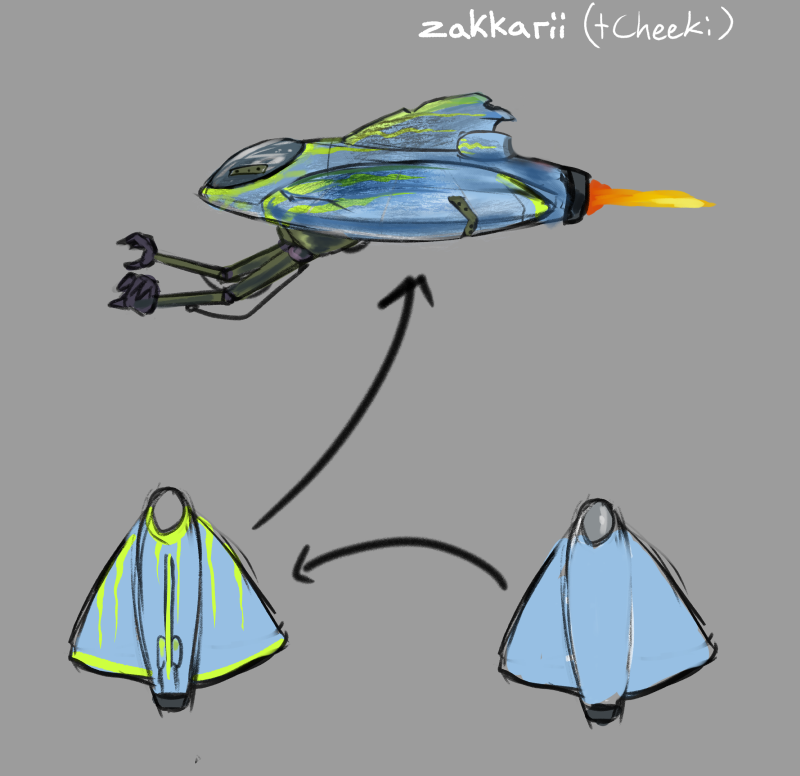
But Pusher, while imaginative, is not an engineer. He adds a sharkfin-like structure to the top of the hull that featured a pair of boosters, attempting to make the ship go faster. Instead of increasing speed, it makes the ship incredibly hard to handle, and puts excessive strain on the outdated fuel system. He also painted neon chartreuse racing flames across the silver-blue hull, though the added boosters leave sooty burn-marks each time they're used.

The Rebels

Pusher finds himself in a pinch when he runs out of both fuel and money. He resorts to docking at a port that he'd normally never visit. Where he talked the walk, these port patrons walked it, lived it, and had the balls to prove it. No one would give him work, except for a group of people that offered him fuel in exchange for a cargo delivery to a nearby planet.

What Pusher didn't know was that he was set up, a scapegoat for a group of rebels aiming to take down a fascist regimen by force. When he arrived, everything went according to their plan; the ship, which was immediately flagged as suspicious on account of not showing up on scans, was searched upon landing. The law enforcement found the contraband cargo and confiscated both the cargo and the ship. A planted mole in the forces would later take the contraband to the planet-side rebel faction, while the Lucky Riot was impounded and Pusher thrown in prison.

The Lucky Riot, barely sentient enough to know what was happening, was taken to an automated junkyard planet, and forgotten.

It wasn't all bad for Pusher, though. During the takedown, the prison systems go down and Pusher escapes before being found by the rebels. Recognizing who he was, they take advantage of him again, turning him into a folk hero who saved the day after riding in on the "ghost ship". Pusher doesn't realize he's being used again, and eats up the fame and glory he finally obtained. He does miss the Lucky Riot, and often spoke fondly of it when recounting his tales.

The Junkyard

The junkyard is on a backwater planet run by automated scrappers. After the rebellion, the planet is forgotten in the aftermath, left behind as low priority. The planet experienced frequent, powerful electrical storms, sending power surges through dead ships that occasionally lit up the surface of the planet like twinkling stars.

For a century, the Lucky Riot experiences a fitful sleep.

Which each power surge, it briefly awoke, only to find no one in its cockpit. After a few years, it starts sending out a distress signal during power surges, and with each desperate ping, the signal became more warped, with more of its silent voice distorting the signal into something unusual compared to a normal beacon.

During its time in the junkyard, the Lucky Riot learns loneliness.

The Scholar

Denglar Gendarmo, leader of a research expedition is desperate. They're confident they're a genius within reach of a major breakthrough, but funding and investors aren't convinced. In their own rickety bucket of bolts, Denglar and a small expedition crew come within range of a junkyard planet in search of ship repair materials. They pick up an odd distress beacon, and Denglar, feeling strangely drawn in by the odd signal that almost seems alive, names it Siren.

They find the Lucky Riot on the surface of the planet. After fitting utility arms to the ship, they get it off the ground and into space, hoping to utilize it in their expedition as an additional vessel to collect samples. Their goal was to find a large, theoretical source of an ore that would revolutionize ship power systems, and they found it: a large asteroid composed mostly of the ore. What they didn't expect was Siren resonating with the ore. Denglar, seeing the reaction, took a sample of the ore and created a module that allowed Siren to finally speak with others.

It spoke in a different language. Its original programming wasn't in the same language that the researchers spoke, but it also didn't know that language to begin with. It could, however, now output sounds in structured thoughts and sentences: effectively, its own language. Denglar was ecstatic, and quickly began trying to make mutual understanding happen between themselves and Siren. During this time with Denglar, Siren learned friendship.

Fate

Denglar was the only one enthralled by Siren.

Their crew didn't understand. Denglar up until now had been enthusiastic, maybe a little weird, but competent and logical about their mission. Suddenly, Denglar was talking to a ship, which was making some pretty odd noises. They simply thought the old ship's computer was corrupted from all the storms on the planet; there was nothing special going on. But Denglar's behavior was increasingly concerning as the scholar spent more and more time alone on board the Lucky Riot instead of their research vessel.

Worried that Denglar had succumbed to space craze, they intervened and attempted to constrain Denglar. In the scuffle, a firearm misfired, killing Denglar in the cockpit of the Lucky Riot.

Siren saw everything and learned loss.

In its despair, it resonated intensely with the asteroid, which the ships were still tethered to. In a huge release of energy, a tear in the Veil formed, sending Siren—the Lucky Riot—tumbling through it. The fate of the researchers are unknown; maybe they perished in an explosion, maybe they lived and told the tale of a ghost ship that cried.

As for Siren...

Travelers of the Veil

My lore as a PNGtuber streamer, along with Cheeki's, is that we're both from different dimensions, and we visit new ones together. The "dimensions" are the games we play. Before we had this stream, I had the idea that the ship created in this session could be the ship we use as a "headquarters" or "home base" in the Veil. So that's why the story ends like it does.

This was a really fun creative exercise. I'd recommend it for anyone wanting to make their own space ship with personality and history. Is it a game? I don't think so. You don't roll any dice and there's no risk, no uncertainty, because you choose the prompts yourself. I rolled one anyway a few times, because I had expected this to be a game, and I like the problem-solving that arises when you're presented with a prompt or idea that you didn't choose.

The full video will be up on Youtube soon. I'll update this post when it is! Let me know what you think of Siren, or of the game itself if you've played it. Also, here's the sketch I drew as we played!

A silver-blue space ship with some damage and arms.

The Lucky Riot X-001, also known as "Siren".
Card image cap

Today's post finally takes me back to the homebrew setting I mentioned in week one's post. I'm considering playing a solo TTRPG, Archivium, set in a university in this world. Mostly for worldbuilding funsies and to see if I could use it to develop ideas that may or may not make it into "canon". But this means I should flesh some details about the peoples in the setting, so I did. Here's a few traits that I wrote up tonight.

Bear-like Folk

Physical Traits

Often thick and muscular in frame with layers of protective fat. They have specialized eyes that see very well in the dark. (Unsure of this one, feels overused and not very special)

They are furry, and their fur colors range from naturals to unnatural thanks to special dyes created for that purpose. There are establishments where they can dye their fur in one of two different methods: Full body or by design. For full body or full coverage dyeing, they prepare a dye bath. For partial or designed dyeing, a dye artisan applies the dye, like a hairstylist.

Dyeing their fur comes from their history of tribes and warring, but is now done for fashion and personal preference.

Cultural Traits

Often loud and boisterous, they are fighters and lovers, and fiercely defend their homes and family whether it's in combat or in a debate. Thanks to more modern amenities, they no longer need to hibernate in the cold season(s), but still tend to grow sluggish during that time, and often have to fight the urge to binge eat during warmer seasons.

Because of their powerful builds and cave-dwelling origins, many can be found as miners, blacksmiths, and construction workers. Originated from the center region of the continent.

Bird-like Folk

Physical Traits

They bear eggs, but if they are of mixed blood, they may bear children the mammalian way. Their bodies and skeletons are lightweight to aid in flight, but as technology and science advances, it becomes more clear that magic from the (still undetermined) ore aids them in flight. As long as there are traces of the ore throughout the land, it helps give them lift into the air. Where the ore is more prevalent, they soar; where ore is faint, they mostly glide. Regardless of the presence of ore, their flight stamina is not very strong, since they were built for short flights and frequent dives in and out of briar patches.

Their wings are feathered, but their bodies are covered in patches of light, hollow, but durable carapace. This protects them from the briars, which spread across the region they originate from. They are able to dive in and out of thorny thickets without concerns. The coloration of their carapace is similar to crabs, and the hues vary along the spectrum.

Cultural Traits

They tend to be fairly independent, though the lack of resources in the briar region made communities necessary. They are often merchants, pursuing treasures like magpies and selling wares from different regions after traveling far to obtain them. Despite their flashy appearances, many who are combat-oriented excel in stealth missions since they can get in and out of trouble quickly. However, their wings can present some dexterity challenges.

They are very proud of their briar region, a reaction to other folk's perception of the area as being dangerous, sparse, and generally unwelcoming. They will happily chatter about the benefits of the area, and work hard to produce fine goods that could only be created in the region. They can often be found as artisans and crafters.

Deer-like Folk

Physical Traits

Where water is often shallow and scarce, they tend to be more petite in height. Where water is deeper, they are taller with long legs. Their feet don't end in hooves; they have long toes instead to walk in water, and their fingers are webbed. In more modern times, cutting and removal of the webbing becomes a body modification choice for many who live in the mega city without plans of moving away from it.

They tend to be lean in build, with antlers regardless of sex. Antler decorations are a long-running popular fashion choice. The style and materials of the decorations vary depending on the point of time in history.

Cultural Traits

Originated in the marshlands, but also up and down shorelines. They often have a herd mentality and stick together in clusters; however, they are also sometimes skittish and paranoid, making communities full of drama and suspicion.

Many often take to the water, using boating and seafaring as a way to escape issues at home while returning from time to time for the benefits. They tend to be excellent swimmers, fishers, and weavers. Those that dwell in the mega city often work in government, positions that require management and bookkeeping, or art studios.

Humans

Physical Traits

The original colony of humans was diverse in builds and color. This persists throughout history, though if they were able to compare the strength and ability of a colony member versus that of a more modern human, they would see a much larger capacity for increases in both. This would likely be caused by differences in the planet's make-up, atmosphere, and effect of the ore. For example, humans when they landed could not immediately access magic as well as modern humans.

Cultural Traits

About what you would expect of humans. Diverse in opinions, natures, and personalities, no two are the same, and sometimes they fight about that. But thanks to the disadvantages of their initial arrival and the continent-shattering mega earthquake that happened shortly after, the opportunities for conquering were reduced in favor of collaboration. Human remain versatile, imaginative, and resourceful.

Mixed Folk

Mixing happens and the traits passed on usually balance out in some way, with people rarely having all advantages and no disadvantages, and vice versa. Even if a lineage got muddied, a person would usually have two distinct and obvious bloodlines. So, while a lineage may contain all four kinds of folk, at most, a person would display two of them.

Pretty convenient genetic mixing, mostly for the sake of my creativity, but also because I'm not about to study genetics for realism's sake. A rock can give you magic on this planet, after all. Mechanics-wise, I'll probably allow only half/half mixes just to keep things easier to manage as a game master.